Flat Foot Surgery
Frequently Asked Questions
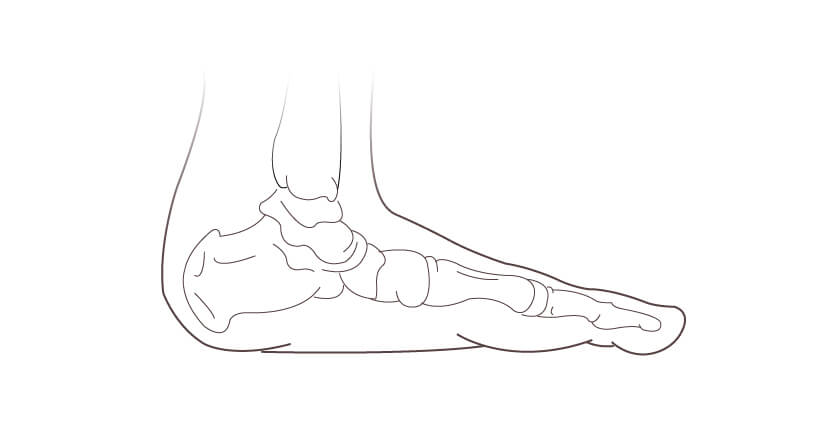
In simple terms, a flatfoot deformity is a structural collapse of the arch of the foot. From a multiplanar aspect you will see the arch collapse as well as the heel sitting in an outward position known as valgus and the front of the foot will be visible in a more abducted position as in facing towards your outer leg when you look from a person standing behind the individual. It is important to note that not all flatfoot problems are pathological and different population groups present with different arch heights.
Genetics play a big part in developing or acquiring a flatfoot. Having a low arch alone with no pain or functional disability is not of any concern. However, broadly classifying flat feet there are two main subtypes.
- Congenital flatfoot. This typically is a congenital problem where the most common cause is known as a tarsal coalition. Essentially the hindfoot joints do not separate and are fused resulting in increased stiffness of your foot in a flatfoot position throughout your teenage years and adult life. Typically, symptoms develop between the age of 9 and 15 and can progress from there.
- The second subgroup is acquired flatfoot deformity, and this can be either due to trauma or failure of the tendon and ligamentous structures through injury or disease which results in an acquired flatfoot. The initial presentation is a flexible deformity which becomes rigid over time due to arthritic changes. Some patients have an element of benign joint hypermobility in which case their ligaments are too lax and they develop flat feet which causes generalised musculoskeletal complaints of the lower limb.
Essentially it means that the flatfoot deformity is corrected. This can be done in a combination of methods which could involve using extra-articular implants to stabilise the feet, cutting and resetting the heel bone to realign the hindfoot, fusing the midfoot joints to reduce the collapse of the arch, tendon transfer to improve the strength of the arch and function of the foot.
Minimally invasive flatfoot surgery would involve using specialised instruments to cut and reset the hindfoot joints, in particular the calcaneus heel bone to centralise and then use screws through small incisions to allow the repositioning of the heel bone. However, it could also involve a procedure called an arthroereisis procedure and a typical implant used is an HyProCure implant which corrects flexible flat feet through keyhole or minimally invasive surgical intervention.
Yes. Flat feet can be corrected if they are pathological and cause pain and appear to be progressive in their nature with surgical intervention.
Flatfoot surgery is necessary where there is disease or pathology related to tendons or ligaments that has caused an acquired flatfoot deformity. It is also essential where function is compromised and conservative treatments have failed. It is also essential when there is pain and functional disability.
The time ranges depending on the surgical intervention required. For example, the HyProCure procedure may only take 10 to 15 minutes whereas a full reconstruction and tendon transfers could take anything from two to two and a half hours.
The return to activity would very much depend on the type of surgery. Minimally invasive surgery may require a period of immobilisation for a couple of weeks and then careful mobilisation but full return to activity may still be many months. Significant reconstructive surgery could involve 6 to 12 months before one is returning back to sports or any aggressive activity.
The cost varies again depending on the procedure. It could range from £5,000 to £10,000 depending on the type of operation.
The appropriate shoes which are a rigid trainer with good arch support is essential. One could also wear orthotics or specialised insoles or devices to support their arch during the gait. A range of exercises can also be used to improve strength of the foot.
The simple exercises that can help include single heel raise exercises to stand and try to elevate your heel and place your weight on the forefoot and to repeat this. Trying to pick a towel up with your toes from the floor or a piece of paper to strengthen your arch. Stretching the calf muscles can also help.
After a period of rehabilitation one should be able to return back to walking and exercise. This is very much dependent on individual cases in terms of exercise return.