Minimally Invasive Bunion Surgery: A Patient Guide
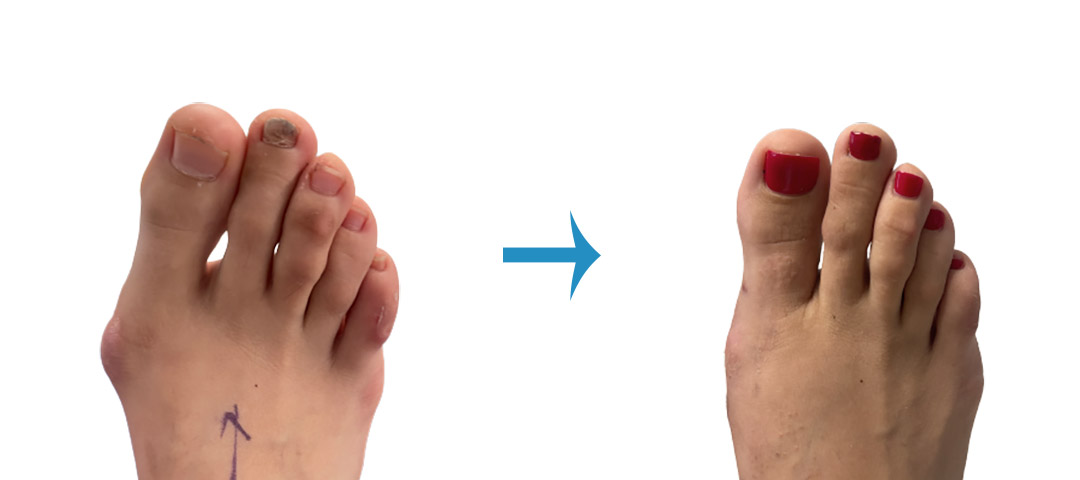
What is minimally invasive bunion surgery?
Minimally invasive bunion surgery corrects a bunion through a few small cuts in the skin instead of one long incision. Fine instruments are passed through the cuts to divide and realign the bones of the big toe, guided by X-ray, and the bones are then held with screws while they heal. It is a recognised option for correcting bunions.
You may also see it called keyhole bunion surgery, percutaneous bunion surgery, MIS, MICA or PECA. Whatever the name, it is still an operation on the bone. There is no truly “non-invasive” bunion surgery, because the bones have to be cut and reset to straighten the toe.
This guide explains how the operation works, what the evidence says, who it suits, recovery, risks, and your options on the NHS, privately, with insurance or as a patient travelling from abroad. For prices and booking, see our keyhole bunion surgery page.
Minimally invasive bunion surgery at a glance
| What it treats | Painful bunions (hallux valgus) that have not settled with simpler measures |
|---|---|
| Incisions | A few cuts of 2 to 4 mm |
| Operation time | About 60 minutes |
| Anaesthetic | Local or general anaesthesia, often with sedation |
| Hospital stay | Day case, home the same day |
| Walking | Weight bearing is usually allowed straight away, in a post-operative shoe |
| Fixation | Small screws, usually left in permanently |
| Normal shoes | Around 6 to 8 weeks |
| Full healing | Around 12 months |
| Evidence base | Similar results to open surgery in studies |
What causes bunions, and when is surgery considered?
A bunion is a bony lump on the side of the foot by the big toe. The big toe points towards the other toes, and the joint can become red, swollen and painful, especially in shoes (NHS).
For most people the exact cause is not clear. Some types of footwear may play a part, a small number of bunions are linked to inherited conditions affecting the structure of the foot, and bunions are most common in women and in middle and later life.
Surgery is considered when a bunion is very painful or has a major effect on your life. The NHS does not offer bunion surgery only to improve how the feet look. Some local NHS areas also set their own criteria before funding surgery.
What are the symptoms of a bunion?
The main symptoms of a bunion are:
- A hard lump on the side of the foot, by the big toe.
- The big toe pointing towards the other toes.
- Hard or swollen skin over the lump, which may look red or darker than the skin around it.
- Pain along the side or bottom of the foot, usually worse when wearing shoes and walking.
Bunions are not always painful. How a bunion looks does not decide whether you need surgery. How much it hurts and how much it affects your daily life does (NHS).
Can a bunion be treated without surgery?
Non-surgical treatment can ease the pain, but it cannot remove a bunion or stop it getting worse. Only surgery straightens the toe. Things that can help include:
- Wide shoes with a low heel and a soft sole.
- Soft bunion pads from a pharmacy to stop shoes rubbing.
- Insoles, toe spacers or toe splints, advised by a GP or podiatrist.
- Paracetamol or ibuprofen, and an ice pack for up to 5 minutes at a time.
- Losing weight if you are overweight.
You may be able to see an NHS podiatrist without a GP referral. If these measures have not helped and pain is affecting walking, work or footwear, it is worth discussing surgery.
For more on bunion symptoms, how bunions progress and what happens if one is left untreated, read our guide to bunions.
How keyhole bunion correction works, step by step
The operation takes about 60 minutes and you go home the same day. Through incisions of 2 to 4 mm around the big toe:
- The first metatarsal is cut. This is the long bone behind the big toe. Its head has drifted outwards, which creates the bump.
- The bone is shifted into a straighter position. The alignment is checked on live X-ray, because the bone cannot be seen directly through such small cuts.
- Two small screws hold the metatarsal. They keep the bone stable while it heals, which is why you can usually walk in a post-operative shoe straight away.
- A small wedge is taken from the big toe bone. This is called an Akin osteotomy. It turns the toe so it sits straight, and one screw holds it.
- The bony bump is smoothed away. This is done through the same small cuts.
For a small number of people with a very large or unstable bunion, a different operation called a Lapidus fusion gives a more reliable correction. Your X-rays show which approach suits your foot.
Types of minimally invasive bunion surgery
Minimally invasive bunion surgery has developed over several “generations”. The main difference between them is how the bone is cut and how it is held while it heals.
| Technique | What it means |
|---|---|
| Early techniques without fixation | The bone is cut but not held with screws. One such technique (Reverdin-Isham) has been found to give insufficient correction, based on low-quality evidence. |
| MICA (third generation) | Minimally invasive Chevron-Akin. A cut near the head of the first metatarsal lets it slide into a better position, fixed with one or two screws, usually with an Akin cut on the big toe. |
| PECA (third generation) | Percutaneous Chevron-Akin. A very similar technique, also fixed with screws. |
| META and other fourth-generation techniques | Newer techniques, such as META, use a different cut through the metatarsal and are fixed with two screws. |
Reviews of the evidence cover minimally invasive techniques where the bones are held with screws, wires or plates, and have found no robust evidence that one technique works better than another. In practice, the surgeon’s training and experience in the technique matter more than its name.
For open operations and other bunion procedures, read our guide to types of bunion surgery.
Minimally invasive vs open bunion surgery
| Minimally invasive surgery | Open surgery | |
|---|---|---|
| Incisions | Several cuts of 2 to 4 mm | One longer cut along the side of the big toe |
| How the bone is seen | Live X-ray guidance | Directly, through the open wound |
| Fixation | Small screws, usually left in | Screws or staples, often left in |
| Walking | Usually allowed straight away in a post-operative shoe | Depends on the operation and your surgeon’s advice |
| Early pain | Lower in several studies | Higher in the first days and weeks in those studies |
| Overall results | Similar to open surgery | The long-established standard |
Benefits
- Smaller cuts and less disturbance of the soft tissue around the joint.
- Lower early pain in several studies.
- Weight bearing is usually allowed straight away.
- Smaller scars.
Limitations
- The surgeon cannot see the bone directly and relies on X-ray, so it should only be done by a clinician with specific training and specialist experience.
- It uses more X-ray time during the operation than open surgery.
- It does not suit every foot. Significant arthritis, weak bones or a very unstable bunion may need a different operation.
- As with any bunion surgery, toes may be stiffer or weaker, may not be perfectly straight, and the bunion can come back.
For a fuller comparison, read minimally invasive vs traditional bunion surgery.
What does the evidence say?
A national review published in June 2024 reached these main findings:
- Minimally invasive techniques work as well as standard open surgery.
- Patient-reported outcomes, such as pain and recovery time, are similar to open surgery overall.
- There are no major safety concerns.
- Every case should be recorded on a registry, such as the British Orthopaedic Foot and Ankle Society (BOFAS) registry, including how patients do in the short and longer term.
The studies reviewed also showed:
- Improvement in function, pain, toe alignment and satisfaction was broadly similar to open surgery.
- In one randomised trial, the bunion came back in about 8% of feet after minimally invasive surgery and 9% after open Chevron surgery at five years.
- Screw removal at a later date was common. In one large case series, 6.3% of patients had a screw removed for any reason.
What’s new in minimally invasive bunion surgery?
- Stronger support. Guidance published in 2024 now recommends minimally invasive bunion surgery as an option, with standard arrangements.
- Outcome registries. Surgeons are asked to record every case and its long-term results, which will build stronger UK evidence over time.
- Fourth-generation techniques. Newer techniques such as META use a different bone cut with two-screw fixation.
- Keyhole Lapidus fusion. Minimally invasive approaches are now also used for Lapidus fusion. One retrospective study found fewer wound-healing problems and non-unions than with open Lapidus surgery.
Who is suitable for minimally invasive bunion surgery?
It may suit you if your bunion is painful, simpler measures have not helped, and your bones are healthy enough to hold the screws while they heal. A different operation may be better if you have significant arthritis in the big toe joint, weak bones such as from osteoporosis, or a very large bunion with an unstable joint at the base of the metatarsal.
Tell your surgeon if you smoke, have diabetes, poor circulation, rheumatoid arthritis or have had bunion surgery before. The NHS notes that foot problems can be more serious for people with diabetes.
Preparing for surgery
- Stop smoking and cut down on alcohol. This helps speed up recovery and lowers the risk of complications.
- Get long-term conditions under control. Conditions such as diabetes or high blood pressure should be managed as well as possible before an anaesthetic.
- Follow eating and drinking instructions. These depend on the type of anaesthetic you have.
- Arrange help at home. Someone needs to take you home, and you will spend most of the first two weeks resting with your foot raised.
- Prepare your home. Keep everyday items within reach and clear trip hazards before the day.
Anaesthesia: will I be awake?
Minimally invasive bunion surgery can be done under local or general anaesthesia. The main options are:
- Local or regional anaesthetic numbs the foot or leg so you feel no pain, while you stay conscious.
- Sedation makes you feel sleepy and relaxed, and is often combined with a local or regional anaesthetic.
- General anaesthetic means you are fully asleep during the operation.
Most of our patients have the operation under sedation with the foot numbed. Your anaesthetic options are discussed with you before surgery. After a general anaesthetic, you should not drive, drink alcohol or make important decisions while the effects wear off.
What recovery looks like
You walk in a post-operative shoe on the day of surgery and spend most of the first two weeks resting with your foot raised. Most patients are in trainers at about 2 weeks and back in normal shoes by 6 to 8 weeks. Swelling settles gradually over several months, and full healing takes around 12 months.
For bunion surgery in general, the NHS advises resting with your feet raised for at least 2 weeks, avoiding driving for 6 to 8 weeks, staying off work for 2 to 12 weeks and avoiding sports for 3 to 6 months. Our keyhole bunion surgery page has the full week-by-week plan.
How painful is recovery from bunion surgery?
Most people have some pain, swelling and bruising after bunion surgery, and it is usually worst in the first few days. In several studies, early pain was lower after minimally invasive surgery than after open surgery, although overall patient-reported outcomes were similar.
Pain is usually managed with:
- Painkillers, taken as advised rather than waiting for the pain to build up. A local anaesthetic block is administered to numb the foot. Pain medication is prescribed to be taken at home.
- Resting with your foot raised for most of the first two weeks, which helps the swelling to settle.
- Wearing the post-operative shoe and walking only short distances at first, as your surgeon advises.
Swelling settles gradually over several months, so the foot can feel tight or ache after activity for some time. Pain that is getting worse instead of better, or that comes with redness, heat, leaking from a wound or a high temperature, should be checked. See “When to get help” below.
Risks and complications
No major safety concerns have been found with minimally invasive bunion correction. Like any operation, it still carries risks, including:
- Infection or skin irritation around the small wounds.
- Bone healing slowly or not joining (non-union).
- A screw causing discomfort and needing removal later.
- Stiffness, or the toe not being perfectly straight.
- The bunion coming back.
- A blood clot in the leg (DVT). Recent surgery is a risk factor.
When to get help
- Contact your surgeon if a wound becomes more painful, red, hot or starts to leak, or you have a high temperature.
- Get urgent advice if you have throbbing pain or swelling in one calf or thigh.
- Call 999 if you have leg pain or swelling with shortness of breath or chest pain.
NHS or private treatment?
On the NHS
- A GP can refer you for bunion surgery if your bunions are very painful or have a major effect on your life.
- For non-urgent, consultant-led treatment, you have the right to start treatment within 18 weeks of referral, with some exceptions.
- Whether a minimally invasive technique is offered depends on your local service and surgeons.
Going private
- You can book a consultation directly, without waiting for an NHS referral.
- Paying for a private consultation does not take away your right to NHS care.
- If you have a complication after private surgery, contact us.
- Check how much bunion surgery costs here.
Using private medical insurance
Private medical insurance may cover bunion surgery, but cover varies between policies. Before you book:
- Check that your policy covers bunion surgery, the surgeon and the hospital.
- Ask whether your cover includes the consultation, X-rays and follow-up appointments.
- Check any excess you need to pay.
- Get an authorisation code from your insurer before your consultation or surgery.
We work with all major private medical insurers, including AXA PPP, Bupa, Cigna, WPA, Allianz, Vitality, Aetna, Healix. Contact our team if you have any questions regarding medical insurance.
Travelling to London for bunion surgery
If you are travelling from elsewhere in the UK or from abroad for surgery, plan for these points:
- Private treatment is the usual route. If you are not ordinarily resident in the UK, NHS hospital treatment is generally charged for, so overseas patients usually have their surgery privately.
- Insurance. If you have international medical insurance, check it covers planned surgery in the UK and get written approval before you travel.
- Plan your stay. Mr Kaser Nazir will discuss how long you should remain in London before returning home. This can depend on whether you are having surgery to one foot or both feet, distance you need to travel and care you have at home.
- Flying home. Recent surgery and journeys of more than 4 hours by plane, car or train both raise the risk of a blood clot. Agree your travel date with your surgeon.
- On the journey. Wear loose clothing, drink plenty of water, avoid alcohol, walk around when you can and move your legs and feet every 30 minutes.
- Bring your records. Previous X-rays, scan reports and a list of your medicines help us plan your treatment.
- Follow-up. Remote consultations are possible following surgery. X-rays are required to assess bone healing which you can arrange locally and then provide images.
Questions to ask before you decide
It helps to ask these questions before this type of procedure:
- What are the possible benefits, and how likely am I to get them?
- What are the risks or side effects, and how likely are they?
- Will I have to stay in hospital?
- What happens if it does not work or something goes wrong?
- What happens if I decide not to have the procedure?
- Are other treatments available?
Frequently asked questions
Yes. Reviews of the evidence have found that minimally invasive techniques work as well as standard open surgery, with no major safety concerns. Results depend on choosing the right patients and on the surgeon’s experience.
It can be if your bunion is painful and wider shoes, pads or insoles have not helped. It is still an operation with a recovery period, and the NHS notes that toes may be stiffer or not perfectly straight afterwards. A consultation helps you weigh this up for your own foot.
Recovery takes time, and the result is not guaranteed to be perfect. After any bunion surgery, toes may be stiffer or weaker, may not be perfectly straight, and the bunion can come back (NHS). Because the surgeon cannot see the bone directly in keyhole surgery, it should only be done by a clinician with specific training and specialist experience. A screw may also need to be removed later: in one large case series, 6.3% of patients had a screw removed for any reason. Other risks include infection, slow bone healing and blood clots. No major safety concerns have been found. See “Risks and complications” above for the full list.
Surgery is not done only to improve how the feet look. It may also not be right if your bunion causes little pain, you have significant arthritis or weak bones, or you cannot rest your foot for the first two weeks.
There is no set point. A GP can refer you for surgery if your bunions are very painful or have a major effect on your life. Surgery is usually considered when simpler measures such as wider shoes, pads and insoles have not helped. The size of the bunion alone does not decide it, and surgery is not done only to improve how the feet look.
There is no single definition. Surgeons usually judge how severe a bunion is from how painful it is, how far the big toe has turned and what the X-rays show. A smaller bunion can still be very painful, and a large one is not always the most painful. A very large bunion, or one with an unstable joint at the base of the metatarsal, may need a different operation such as a Lapidus fusion rather than a keyhole correction. Your X-rays show which approach suits your foot.
No. Wide shoes, bunion pads, insoles, toe spacers and painkillers can ease the pain, but only surgery removes a bunion. The NHS says you cannot get rid of a bunion or stop it getting worse yourself, so exercises and home remedies cannot dissolve or straighten one.
Sometimes. A small number of bunions are linked to inherited conditions affecting the structure of the foot, but for most people the cause is not clear.
No. Most bunions develop gradually, and they are most common in middle and later life. Some people inherit a foot shape that makes a bunion more likely, and footwear may play a part, but you do not need to be born with one.
The NHS says you cannot stop a bunion getting worse yourself, but you can ease the pain. Wide shoes with a low heel and a soft sole, bunion pads and insoles can help, and high heels and pointed shoes are best avoided. If the bunion is becoming more painful or harder to fit into shoes, see a GP or podiatrist, or book a consultation to talk about surgery.
Other problems can cause pain or a lump near the big toe, including gout, arthritis in the big toe joint and bursitis. A Tailor’s bunion (bunionette) looks similar but forms on the outer side of the foot, at the base of the little toe, and is treated separately. A GP, podiatrist or surgeon can tell them apart from an examination and X-rays.
Your GP is usually the first step. They can look at your foot and may refer you to a podiatrist, and you may be able to refer yourself to an NHS podiatrist without seeing a GP. Bunion surgery is done by a foot and ankle surgeon. For minimally invasive surgery, the surgeon should have specific training and specialist experience. Mr Kaser Nazir is a consultant podiatric surgeon who specialises in minimally invasive bunion correction. He has performed more than 1200 minimally invasive bunion surgeries.
The procedure takes approximately 45 minutes, you will stay in the hospital for half a day. You go home the same day.
Yes. Weight bearing is usually allowed straight away. You walk short distances in a post-operative shoe and rest with your foot raised for most of the first two weeks.
Most patients are in trainers at about 2 weeks and normal shoes by 6 to 8 weeks. Full healing takes around 12 months.
Most people have some pain and swelling, usually worst in the first few days, and it is controlled with painkillers and by resting with the foot raised. In several studies, early pain was lower after minimally invasive surgery than after open surgery. See “How painful is recovery from bunion surgery?” above for more.
Not strict bed rest. You walk in a post-operative shoe on the day of surgery, but you spend most of the first two weeks resting with your foot raised, which helps the swelling to settle. The NHS advises staying off your feet as much as possible for at least 2 weeks after bunion surgery. Your surgeon will tell you how much walking is right for you.
A post-operative shoe for the first 2 weeks, then sandals or rigid-sole trainers, and normal shoes at around 6 to 8 weeks. Choose shoes with plenty of room for your toes and avoid high heels and pointed shoes, as the NHS advises.
Agree a date with your surgeon first. Recent surgery and long journeys both raise the risk of a blood clot, especially journeys of more than 4 hours.
Yes, for suitable patients. Having both feet done affects how much you can walk in the first few weeks, so your surgeon will discuss whether one or both suits you better.
Yes. The annotated X-rays in the step-by-step section show a foot before and after minimally invasive correction, with the screws in place. Our team can provide you with before and after pictures, alternatively please visit our before and after gallery.
Minimally invasive bunion correction is a recognised option, but whether it is offered depends on your local NHS service and its funding criteria.
You have the right to start non-urgent, consultant-led treatment within 18 weeks of referral, with some exceptions, and actual waits vary by hospital (NHS).
It may, but cover varies between policies. Check your cover and get an authorisation code before booking.
Usually, yes. Screws used in bunion surgery are often left in permanently. Some people need one removed later if it causes discomfort.
It can. Bunions sometimes come back after any bunion surgery. In one five-year trial, the rate was similar after minimally invasive and open surgery.
It may be possible, but it needs careful assessment. The NHS notes that foot problems can be more serious for people with diabetes, so tell your surgeon and keep your condition as well controlled as possible before surgery.
Find Out More
If you have any other questions or would like to reserve an appointment at our practice, don’t hesitate to get in touch with our team: