Types of Bunion Surgery
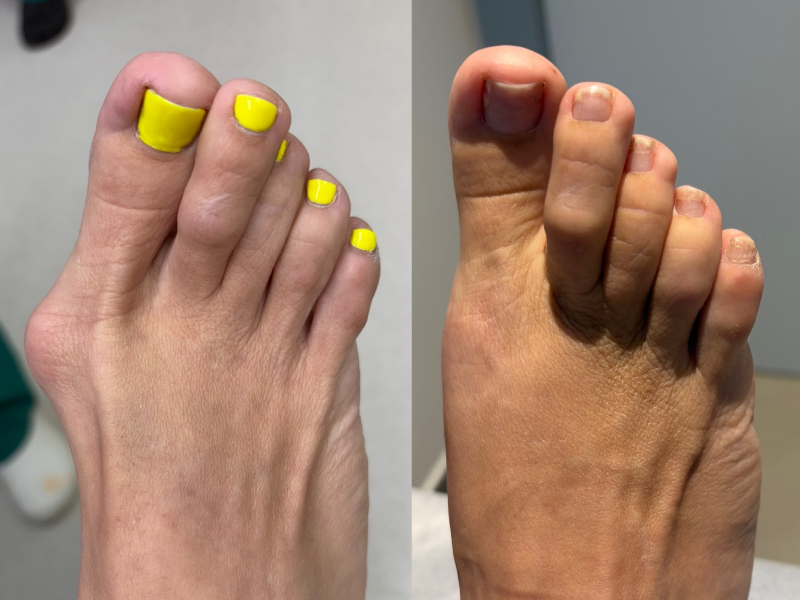
Several types of bunion surgery are available, and the right choice depends on the severity of the deformity, the stability of the foot, bone quality, and whether arthritis is present in the big toe or midfoot joints.
The most significant recent advance in bunion surgery is minimally invasive (keyhole) surgery.This technique has transformed treatment by correcting most bunion deformities through small incisions rather than open surgery, allowing for earlier mobilisation and less disruption to the surrounding tissue.
Traditional bunion correction involves cutting and realigning the bone – a procedure known as an osteotomy performed either through open surgery or the newer keyhole approach. In suitable patients, modern minimally invasive techniques can now correct mild, moderate, and even large bunion deformities, with the benefits of smaller incisions, reduced soft tissue trauma, and a faster return to weight-bearing.
Fusion procedures, such as Lapidus fusion or first MTP (big toe) joint fusion, are generally reserved for cases involving joint instability, midfoot arthritis, or arthritis in the big toe joint itself.
Bunion Surgery Types at a Glance
| Type of Bunion Surgery | What It Involves | When It’s Usually Considered | Key Point |
|---|---|---|---|
| Minimally Invasive (Keyhole) Osteotomy | The metatarsal bone – and sometimes the big toe bone – is cut and realigned through small incisions, using X-ray guidance and screw fixation. | Suitable for many mild, moderate, and large bunion deformities where there is no significant arthritis or midfoot instability. | Corrects the deformity through minimal access, with less soft tissue disruption and earlier mobilisation. |
| Scarf and Akin Osteotomy | An open procedure in which the metatarsal bone and big toe bone are cut and realigned, usually secured with screw fixation. | Traditionally used for mild to moderate bunion deformities. | Long considered the gold standard, but involves a larger incision than keyhole surgery. |
| Lapidus Fusion | Fusion of the joint at the base of the first metatarsal. | Indicated when there is instability or arthritis at the midfoot joint. | Helps prevent recurrence when midfoot instability is the underlying cause. |
| First MTP Joint Fusion | Fusion of the big toe joint. | Indicated when there is arthritis in the big toe joint. | Corrects the deformity while also addressing arthritic pain. |
| Bunion Shaving / Exostectomy | Removal of the bony bump without fully realigning the joint. | Rarely used as a standalone procedure. | Generally insufficient on its own, as it doesn’t address the underlying deformity. |
Also Check: Types of Bunion
Most common bunion operations involve an osteotomy procedure where the metatarsal bone is cut and repositioned. Alongside this, a secondary procedure known as an Akin osteotomy is performed, which is a bone cut of the big toe bone to realign the toe in a straight position.
The scarf and Akin osteotomy was considered gold standard for many years as it allowed correction of mild to moderate bunion deformities and stable fixation such as screws to allow early mobilisation but still involved a large incision and an initial period of very limited weight bearing.
More recent advances in terms of minimally invasive surgery allow a similar operation to be performed where the metatarsal and the proximal phalanx is cut and reset with the use of screws, known as generation four minimally invasive bunion surgery, which is performed through minimal access techniques under direct X-ray guidance and visualisation, allowing early mobilisation with minimal disruption of soft tissue and therefore very limited wound problems.
Historically, for large bunion deformities, with or without instability of the midfoot tarsometatarsal joint, the Lapidus fusion was considered the gold standard. However, minimally invasive bunion surgery has allowed surgeons to correct larger deformities where there is no significant instability at the midfoot without the need of fusing a joint unnecessarily. Where there is arthritis of either the first MTP joint, which is the big toe joint, or the midfoot joint, then the Lapidus procedure or the first MTP joint fusion procedure for arthritis of the big toe joint remains gold standard, as correction of any bunion deformity with arthritis carries an increased chance of continued pain and disability.
Before and After Bunion Surgery Images: https://www.londonfootandanklesurgery.co.uk/before-and-after-surgery-image-gallery/
Why Are There Different Types of Bunion Surgery?
The bunion deformity is a three-dimensional malalignment of the first metatarsal and the big toe joint. Each bunion surgery over time has tried to address some parts of the deformity and cannot necessarily address all aspects of this three-dimensional deformity. However, minimally invasive surgery has allowed surgeons to correct all aspects of this deformity, including the widening of the foot, the rotation of the big toe, and the alignment of the cartilage.
The different types of bunion surgery have developed over time, and surgeons have become proficient in doing one technique over another.
Also Check: Bunion Causes
What is Checked Before Choosing an Operation
Examination of the foot in terms of stability, the degree of deformity, whether there is hypermobility at the midfoot joints, and whether the joint deformity is reducible manually are typical aspects that are examined during clinical examination. Furthermore, any joint pain and any signs of arthritis are examined in terms of range of motion and pain through range of motion.
1. Bunion Osteotomy – Repositioning of the Bone
An osteotomy essentially means cutting the bone with specialised instruments such as saws or bone burrs, which are used in minimally invasive surgery, and then resetting the bone in the correct position and holding it with screw fixation, allowing the bone to heal in that new position.
2.Scarf and Akin Osteotomies
This was a procedure popularised up until recently, performed by most surgeons in the world. It allows for most moderate and mild deformities to be corrected with excellent results.
3. Minimally Invasive or Keyhole Osteotomy
This is a procedure that is performed by Mr. Nazir at London Foot and Ankle Surgery. He performs this for most bony deformities, whether small, medium, or large. It allows him to perform the procedure through a minimally invasive or keyhole technique. It can address long-standing deformities and allow early mobilisation with less chance of infection, joint stiffness, and recurrence.
Also check: All About Keyhole Bunion Surgery and Cost
4. Lapidus Procedure – Fusion at the Base of the First Metatarsal
This is only reserved in five percent of bunion cases by Mr. Nazir where there is instability or pre-existing arthritis of the midfoot joint, and therefore any other technique will result in recurrence.
5. Other Operations
Other operations include a fusion of the big toe joint. This is when there are arthritic changes in the joint, especially the big toe joint, and correction of the deformity alone will not resolve the problem.
Open Versus Keyhole Surgery
| Aspect | Traditional Open Bunion Surgery | Keyhole Bunion Surgery |
|---|---|---|
| Surgical approach | Traditionally involves larger incisions to access and correct the bunion deformity. | Performed through small keyhole incisions using minimally invasive techniques. |
| Correction of deformity | Designed to address the intermetatarsal angle, hallux valgus angle and other aspects of the deformity. | Can address the intermetatarsal angle, hallux valgus angle and, in experienced hands, larger or more complex deformities. |
| Soft tissue impact | Larger incisions and greater soft tissue dissection may result in more tissue trauma. | Smaller incisions generally result in less soft tissue disruption. |
| Joint stiffness and adhesions | Greater soft tissue disruption may increase the risk of adhesions and postoperative stiffness. | Reduced soft tissue trauma may lower the risk of adhesions and joint stiffness. |
| Risk of infection | Larger surgical wounds may be associated with a higher risk of wound-related complications. | Smaller incisions may reduce the risk of wound-related complications and infection. |
| Weight bearing and mobilisation | Historically, some open procedures required patients to avoid or limit weight bearing for a prolonged period. | Depending on the procedure and surgeon’s protocol, patients may be able to begin protected weight bearing and mobilisation much sooner. |
| Recovery | Traditional techniques could involve a prolonged recovery lasting several months. | Minimally invasive techniques may allow earlier mobilisation and a smoother recovery for suitable patients. |
The surgical approach is only part of the decision. When we look at the types of operation that have historically been performed, they did try to address both the intermetatarsal and hallux valgus angle and all aspects of deformity, but they involved large incisions and soft tissue stripping, which resulted in increased risk of infection and adhesions, which resulted in stiffness. The recovery period was protracted over many months. Patients were not allowed to weight bear on the foot for a protracted period. The recurrence rates were much higher and the risk of complications was also higher.
However, with keyhole bunion surgery, provided that it is done by a surgeon who has a significant amount of experience with this technique and the correct training, this allows the procedure to be performed through small keyhole techniques. This results in less soft tissue trauma, less chance of joint stiffness, less chance of infection due to small incisions, immediate mobilisation to some extent, and can correct larger deformities. Overall, taking into account the risks, they are less and the outcome is more predictable.
For more details: Minimally Invasive Surgery versus Traditional Bunion Surgery
Frequently Asked Questions
An osteotomy is the most common type of bunion surgery. This can be performed by both open and minimally invasive keyhole techniques. Our clinic specialises in performing this in a keyhole technique because it has fewer complications and an easier recovery.
No. The Lapidus procedure was initially, during open surgery techniques, reserved for severe bunions, but with the advent of minimally invasive surgery, this is only reserved for unstable midfoot joints and not for large bunions. Large deformities can now be corrected using the keyhole bunion technique, and therefore the Lapidus procedure is becoming more obsolete in larger bunions.
Recent studies have proven that keyhole bunion surgery has improved patient outcomes in that patients have less post-operative pain, a better chance of returning to normal function in terms of range of motion, less chance of getting infection, and a quicker return to activity. Therefore, keyhole bunion surgery appears to be better than open surgery when performed by the appropriate surgeon.
No. Most bunions are a deformity where there is subluxation of the big toe joint, in that the joint is not in alignment. Shaving the bump merely does not address the deformity and can actually increase the rate of deformity progression.
Yes, provided that the bone quality is sufficient and that the patient is able to rest for the first two to four weeks and mobilise carefully, no more than ten minutes an hour, then bunion operations on both feet could be performed at the same time.
For any support: https://www.londonfootandanklesurgery.co.uk/patient-support/